What I learned about the real Sam Neill while writing his TV series and book about Captain Cook, and why the world is poorer without him
[Originally published on Substack: Human Matters by Meaghan.]
Hearing the news that Sam Neill was gone hit me harder than I thought it might.
I don’t want to talk this up and make it look like our relationship was anything more than it was. Because Sam Neill was not my friend. He had more than enough of those already… not that I wouldn’t have been willing to step up if he had an empty spot on his dance-card that needed filling.
Sam and I were professional associates on the TV series I wrote that he starred in, with a passing connection through the book I wrote based on the series.
That was it.
And, yet.
He made a mark on me.
Did I have a crush on Sam Neill?
Let’s be honest. Who didn’t?
I just looked up the date of Gillian Armstrong’s My Brilliant Career.
1979.
I was basically a foetus when I saw it in the early ‘80s. And yet, Sam’s Harry made me swoon. So much so that all my preschool feminist training fell by the wayside as I wondered what in the actual fuck Sybylla was thinking when (spoiler alert) she ditched Harry and took off in pursuit of a writing career.
So, the first time I met Sam was a surreal experience.
It always is anytime you encounter someone in three dimensions when you’re only familiar with them in 2D form.
And, yes. He was just as swoon-worthy in person. More so, even.
I wasn’t the only one a little starstruck.
I’d flown into Sydney from Melbourne for a meeting at a production company. In one of the glassed-in boardrooms, there was another meeting taking place with a female actress of a certain age many of you would know.
When Sam arrived, I was chatting with a colleague in another corner of the open-plan office, so I hung back.
The actress? Not so much. When she saw Sam, she came bursting out of the boardroom and started gushing about how much she’s always wanted to meet him and how much she admires him.
Not just me, then.
After she released him from her grip and returned to her meeting, it was my turn.
“Hi, I’m Sam,” he said.
Unnecessarily.
“Meaghan,” I replied. “Nice to meet you.”
Because it really was.
We were there to work on a TV series that started its life as “Uncharted.”
By the end, it was title by committee, because the stakeholders all wanted “Sam Neill,” “Pacific,” and “Captain Cook” in the title.
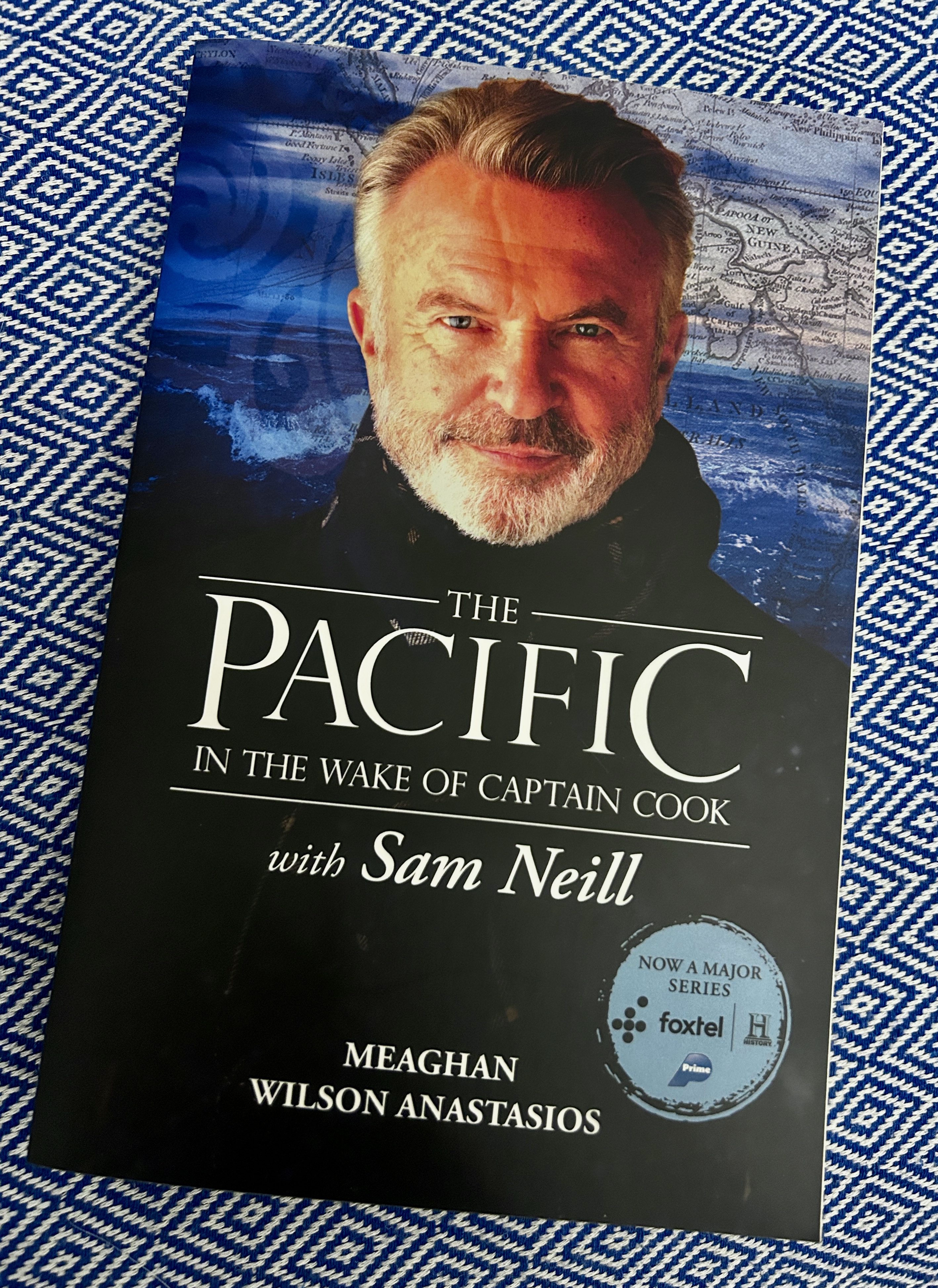
Enter, The Pacific: In the Wake of Captain Cook with Sam Neill.
As a jobbing writer, not all the things I’ve done float my boat (pardon the pun).
The Pacific: In the Wake of Captain Cook with Sam Neill was one out of the box. I’m enormously proud of it.
Unfortunately, the only place you can watch it right now is if you’re lucky enough to be in Finland, where it seems to be playing on a streaming service, or if you happen to stumble across a set of DVDs at a garage sale. But you can get a little taste of it here via the trailer for the series.
And you can still buy the book, as a paperback, or ebook.
My connection with the project started early on.
Sam had been in Turkey shooting a documentary series about Australia and New Zealand’s ill-fated WWI military expedition to Gallipoli, Why Anzac?
That was where he got talking with the Australian director, Kriv Stenders, and the two producers, Alan Erson and Owen Hughes, about another event that looms large in the consciousness of all Antipodeans: the arrival of Captain James Cook on our shores.
Like Sam, Alan and Owen are New Zealanders. Captain Cook has become part of the modern mythology of the place Māori knew as Aotearoa long before Europeans arrived. It’s the same here in Australia.
2019 and 2020 would mark 250 years since Cook arrived in New Zealand and Australia. The occasion would not pass without a commemoration of some sort or another.
Given the experiences of the First Nations people of the Pacific after European colonisers arrived en masse, it also demanded a more critical eye to be cast on what it meant for the people living here when Cook first appeared on the horizon.
When Alan returned to Australia, he got in touch and asked me to put together an outline for a TV series.
But it couldn’t be a story about the Captain Cook we grew up with.
“Discovery”… Really?
All Australians around my age and older were taught that Captain Cook “discovered” Australia. Just like Christopher Columbus “discovered” America.
Even as a kid, I wondered how the fuck it was possible for a place to be “discovered” when people had already been living here for what we now know was at least 65,000 years.
It was the same in New Zealand. The Māori people may not have been there as long as Aboriginal Australians have been living in the southern land of Terra Australis. But Māori found their way there via the waves of Polynesian migration that populated the Pacific over ten thousand years.
People of European descent, by comparison, arrived in this neck of the woods pretty much yesterday.
Rewriting the historical record.
Sam’s initial motivation for telling Captain James Cook’s story was that he had a personal stake in it.
He wanted to salvage his family’s reputation.
It all began when Cook sailed by Norfolk Island in 1774, where he spotted towering pines and forests of flax. The island looked like a goldmine for Cook’s masters at the Admiralty who were struggling to find supplies of trees tall and straight enough to give them masts and sails for the navy Britannia needed to rule the seas.
Turned out the pines were too brittle and the flax too poor to be much use to anyone. So, once Australia was turned into the dumping ground for Britain’s petty criminals (petty only, because serious crime landed you in a hangman’s noose), Norfolk Island won itself a spot as Australia’s penal colony of last resort.
And that was where Sam’s great-great-grandfather, Captain Foster Fyans, arrived as commandant in the 1830s. It was also where he got himself a reputation for being a hard-nosed and brutal overlord known to the convicts as “Flogger Fyans.” And thanks to historian Robert Hughes’s colourful account in his epic history of Australia, The Fatal Shore, that was how he was remembered.
Sam was not at all pleased about that.
He wanted to correct the record.
But by the time we met in Sydney, The Pacific had evolved into something much bigger.
Sam had family connections to Aotearoa’s Māori people through his grandchildren. As he put it, his family in the Pacific were “both colonisers and colonised.”
Family, to Sam, was everything.
In a break during our meeting in Sydney, he asked about my children.
I told him that my young son wanted to be a director, and that my daughter wanted to be David Attenborough. And that they were both massive Jurassic Park fans.
He offered to sign something for them and paused to think for a moment about what he should write.
“You must hate all that,” I said.
“What’s that?” he replied.
“All the fans, I mean… and the fact that the one role you’ll be remembered for is Jurassic Park, when there have been so many wonderful performances.”
“Not at all,” he said. “It’s a privilege to do what I do. Without all that, I wouldn’t have a job.”
He wasn’t just paying it lip service. He was genuinely shocked that I might imagine it to be otherwise.
He handed me two notes; one for each of my children.
For my son, he wrote:
“Roman, it’s a struggle. But persist. Sam Neill.”
Roman put that note in a frame above his desk.
And he did persist. I suspect Sam’s advice stuck. Because today, he is a director.

Nothing comes easily in this industry. Sam knew that better than most.
When he turned up in Sydney, he’d done his research. He turned up with a dog-eared and annotated copy of Cook’s diaries.
Because even if the plan was to create a platform for Pacific First Nations people to share what happened after Cook arrived on their shores, the story had to be framed by an account of what was, by any measure, a series of remarkable sea voyages by a remarkable man.
By the time his third voyage was cut terminally short by the locals in Hawaii in 1779, Captain James Cook had logged more than 320,000 kilometres criss-crossing the globe, most of it in the Pacific.
In terms of distance, it’s the equivalent of sailing to the Moon.
In a boat no bigger than the length of two buses end to end, Cook and his crew travelled from the frozen north—Alaska and the Aleutian Islands—to the icy south, where they became the first Europeans to cross the Antarctic Circle.
He charted everything from Rapanui—Easter Island—to French Polynesia, Tonga, the Solomon Islands, Hawaii, and everything in between. He was the first to map Australia’s east coast and the first to fully chart New Zealand’s North and South Islands.
His skills as a cartographer were so remarkable that some of his charts were still in use in the 1990s.
A big “but”
But what followed Cook’s arrival was utter devastation for the people who had called the Pacific home for tens of thousands of years.
We did not want to recount the story of colonisation. We hoped to present a view from the other side of the beach by hearing from the people who were there when Cook arrived.
Because by mapping a world that had virtually escaped European attention, and by giving the British Admiralty the knowledge they needed to master navigation and venture forth to rule the seas (more on that below), Captain James Cook brought disaster in his wake.
Not that he necessarily intended it to be that way.
Although some disagree, there is a consensus that Cook’s encounters with the First Nations people of the Pacific were generally benign.
For the most part, his diaries reveal a deep respect for the people he encountered.
As a navigator, he marvelled at the knowledge of the Polynesians who found their way from island to island across the vast expanse of the Pacific, despite having none of the scientific instruments European sailors relied upon.
It was hard-won knowledge.
Testicles lashed to the ship’s rigging… Lugged along in the ship’s wake by a rope tied beneath the armpits… Forced to sit as a young child for hours in a tidal pool… Deprived of sleep for days on end.
No, that’s not an account of a fishing trip gone bad. They’re all tried and true techniques of acquiring the skills required to become an exemplary navigator, Polynesian-style.
What better way to observe the ebb and flow of the tides than to sit as a youngster in the rock pools as the tide advances and retreats around you?
And if you suffer from chronic seasickness, floundering along behind the ship for a while will take your mind off throwing up.
As for the testicles?
If the family jewels are literally on the line, a trainee navigator will quickly learn to anticipate the vessel’s movement through the waves and currents.
It meant the Polynesian navigators were streets ahead of Western science when it came to open-ocean navigation.
To them, the Pacific was a landscape to read, as we might follow a river and understand that eventually it will lead to the sea.
A Polynesian navigator could unerringly trace a path seven thousand kilometres over open ocean from Aotearoa (New Zealand) to Hawaii by tracing currents, observing the stars, and reading countless other prompts from the natural world.
For example, it’s thought that some of the first Pacific voyages took place when Polynesians followed the seasonal migration paths of birds that criss-cross the Pacific.
The long-tailed cuckoo breeds and nests in New Zealand over summer before very wisely retreating to Tahiti at the approach of the Southern Hemisphere winter. Polynesians knew there was a landmass somewhere to the south and so followed the flocks of birds to Aotearoa.
Within eighty generations, the Polynesians had populated almost all the island chains in the Pacific.
Their culture had spread across twenty-five million square kilometres of the planet’s surface. To the Polynesians, the Pacific is a watery continent, covered in superhighways their ancestors used to trade and maintain tight cultural and spiritual bonds.
For Europeans, the Pacific was a terrifying and barren space.
Because Western science had failed. Where Polynesians could travel across open ocean without a care in the world, until very recently, European navigators were stuck once they lost track of where they were in terms of longitude.
Think of it this way. Even today, you don’t need to be an expert to travel along a line of latitude—the bands that circle the globe from east to west. Keep the sun in the same spot above your head, and you’re set. If you’re on the equator, it should be right above you. Either side of that, it will be lower in the sky.
But if you’re out at sea without a landmark to orient yourself, you won’t have any idea where you are in terms of longitude—the lines that run from pole to pole.
For the early European navigators, that was a deadly problem.
If they went off piste, they could calculate their location to the north or south by observing the position of the sun and stars. But they were fucked when it came to working out where they were from east to west because there was nothing overhead to distinguish one point from another.
If they had been heading towards a port, they would have no way of knowing if they had overshot the mark, much less know if they were about to smash into a reef.
That was what landed Cook in the Pacific.
He was sent there by his masters in the Admiralty to observe the Transit of Venus across the face of the sun, which would give them the information they needed to formulate a way to accurately measure longitude.
The quest to unravel longitude is a remarkable story I won’t detail here. The full story is outlined in Dava Sobel’s incredible book, Longitude, or you can get a taste of it in my book.
On that and the two voyages that followed, Cook charted much of the Pacific, and ended on a failed attempt to find the Northwest Passage around the top of Canada that the Admiralty was quite sure must connect the North Atlantic and the Northern Pacific.
That was where Cook’s crew almost mutinied when forced to eat walrus.
It’s also why, when I sent Sam to Alaska, I made him eat walrus as well.
All in the name of historical accuracy, of course.
It was, he said, the most disgusting thing he had ever tried.
But to the Inuit people of Alaska, walrus was a crucial part of their diet.
I didn’t learn about the Pacific First Nations’ experience by reading things in a book. Like the rest of the team, I learnt by listening to them and asking questions. As did Sam.
As a historian, it was a revelation. Because it transformed my way of understanding so many things.
History is the tool of victors.
Sure, I knew that—in an academic sense.
But as I spoke with present-day navigators who have revived the Polynesian skills and today travel across the Pacific on enormous canoes as their ancestors once did—without a compass, much less GPS—I understood at a cellular level how much we have lost in the West by ignoring the powerful knowledge preserved by First Nations people.
While the West has been transfixed by cogs and pistons and machines that go “bing,” First Nations people have been listening to nature.
We’ve taken hundreds of years to develop machines that simply prove, in a quantifiable way, many things First Nations people have known to be true for thousands of years; knowledge they have accumulated through observation and intuition.
To their great detriment, the people who came to the Pacific in the wake of Captain Cook dismissed Pacific people and their culture as anachronistic curios.
Which brings me to the tattoo.
If you’re fortunate enough to have seen the series, then you should know that the tattoo was all Sam.
If you haven’t, let me give you some background.
In Polynesian society, tattoos—tā moko—are deeply significant forms of cultural and spiritual expression. They record history, genealogy, and rites of passage. In a society with no history recorded in script on paper or stone, tattoos were the equivalent of a passport, autobiography, Bible, and family history rolled into one.
Traditionally, sacred Polynesian tattoos were applied in the most brutal of fashion. Forget sanitised inked needles in a hipster tattoo parlour. Traditional tā moko are carved into the skin using bone chisels. Enduring the experience without expressing any pain was a big part of the process.
And they didn’t stop at the fleshy bits, either. Facial tattoos were—and remain—a big part of it.
But those facial tattoos gave birth to a ghastly colonial trade.
Along with a Meissen dinner set, a gilt candelabra, and a Giambologna equestrian miniature, it became de rigueur for every British collector worth his salt to own a toi moko—a mummified tattooed Māori head.
Between 1820 and 1831, hundreds of toi moko were taken out of Aotearoa—New Zealand. Although many have been repatriated and returned home, it’s estimated that five hundred remain in foreign lands.
So, imagine what it means for the Māori people to know that the British Museum still has seven Māori ancestors in its “collection.”
Yes, really.
And guess where the trade began?
When Cook’s botanist, Joseph Banks, exchanged a toi moko for a pair of linen undershorts. Yes, a human head for a pair of undies……..
This is the backdrop I wanted to use to frame the story of Cook’s first encounter with Aotearoa’s Māori people.
The linking sequence that fell into my lap was a repatriation ceremony at Wellington’s Te Papa Museum. Ancestors were to be returned to their rightful home amidst mourning, commemoration, and veneration.
Māori elders and museum officials extended an invitation to Sam to watch the proceedings and allowed us to film it.
Using “us” in that context is misleading.
Because the “me” part of “us” was parked at a desk back in Melbourne.
The rise of the internet has been a mixed blessing for me as a researcher and documentary screenwriter.
The first series I researched and wrote, Shane Delia’s Spice Journey: Turkey, sent me to Turkey on two trips to scout locations and talent to feature the best of Turkey’s food, culture, and history. Imagine how good that might be and multiply it by eleventy billion. It was utterly brilliant.
But by the time The Pacific rolled round, there wasn’t much I couldn’t do from my living room with a laptop, a phone, and a reliable internet connection. So, as I mapped what would be Sam’s journey in the footsteps of Captain Cook, from the tropical paradise of French Polynesia to the wild, volcanic landscape of the Solomon Islands, and the vast frozen lands of Alaska, the closest I got to being there was to see some of the daily rushes from the crew in the field, and filmed by directors Kriv Stenders and Sally Aitken.
So, I wasn’t there as Sam stood on the sidelines and watched what would be a deeply moving experience at Te Papa as the descendants of Māori warriors whose heads had been taken to be used as mantel decorations in Georgian England wept and welcomed their ancestors home.
I also wouldn’t be there when Sam got a tattoo.
It wasn’t planned. Because Sam went off script.
The master tā moko artist, Gordon Toi, was Sam’s friend. The plan was to have the two talking on-screen about the cultural importance of ritual tattoos.
I didn’t know what happened until the producer, Aline Jacques, called me.
“You can’t tell anyone, because it’s an extraordinary moment,” she said. “But Sam got a tattoo.”
At Sam’s request, Gordon designed a tattoo to represent Sam’s connection to Aotearoa.
After it was done, Sam wept, but not from pain. It was as if he had crossed a threshold.
He had found his place. It seemed to be the moment he at last came home.
The series and book were released and were well received.
Then, we all went on with our lives.
Until two years ago, when my daughter was in the first year of her journalism course at university. Her first assignment was an interview-based newspaper article.
She had just visited Melbourne’s Creature Technology, and wanted to write about the dying art of puppetry and animatronics in film, and what the rise of CGI meant for actors expected to work against green screens rather than lifelike three-dimensional creatures.
You know where this is going, don’t you?
“Do you think Sam would let me interview him?” she asked. “I can ask him questions by email.”
“Can’t hurt to ask,” I replied. “But I can’t make any promises.”
Other than the odd DM on social media, we hadn’t been in touch for years.
I sent an email, expecting nothing in return. I knew he was in the middle of a production… a gruelling time for any actor.
But a few days later, a warm and friendly response landed in my inbox, including answers to my daughter’s questions.
He wrote, in part:
We had these incredible animatronic dinosaur puppets in Jurassic Park 1, Jurassic Park 3 and Jurassic Dominion. Massive creatures and pretty terrifying to get up close to.
Having these creatures around made life better for all of us actors. And particularly the kids. When a t-Rex head is trying to eat you in a car, it gives you good reason to scream. Simply imagining something like that is far more difficult.
It’s a shame that animatronics are probably finished.
They are harder to produce and more expensive than something made by a nerd on a computer. This is to be regretted. It is no fun acting in front of a green screen. But it is actually quite a lot of fun when you have a 3-dimensional creature about to devour you.
Good luck with the project, Cleopatra.
He owed me nothing.
He owed my daughter nothing.
It was an assignment. The article wasn’t going to be published, so he wasn’t even going to get any publicity out of it.
He would have been well within his rights to ignore my email completely.
But he didn’t.
That’s the kind of man Sam Neill was.
And the world is much poorer for his loss.
He was only a peripheral part of my life. But I’ll miss knowing he’s out there.
And for the rest of my life, I’ll always treasure the extraordinary thing we made.
Subscribe now so you don’t miss a post.
