From ancient myths to modern TV, the “monstrous mother” keeps showing up; it says more about our expectations of women than it does about motherhood.

Ever feel like you’re not measuring up as a mum? Yeah, I feel you.
No Mother’s Day breakfast would be complete without a steaming hot plate of guilt served up with a side of self-doubt.
So, with Mother’s Day on the horizon, here’s something to make you feel a little better about your imagined failings.
Meet the bad mothers.
It’s a theme that persists in Western pop culture in a way that fathers behaving badly never does. Have a quick scan through the TV guide. It’s a go-to plotline that straddles genres, all the way from horror to comedy.
But why has the “monstrous mother” become such a trope? Is it simply that the absence of a mother figure hits us in the solar plexus? Because there’s a reason so many Disney stories begin with the death of a mother.
There’s something more at play, though.
On Mother’s Day, let’s take a look at why pop culture loves a good mum gone bad.
Happy Hallmark Card Day
I’ve always told my kids that I couldn’t give two figs about Mother’s Day. As far as I’m concerned, every day should be mother’s day.
I’m a bit of a fun-buster like that. Hallmark Card days have always made me itch, paced carefully as they are through the year to keep the economy pumping as we meet our KPIs as well-trained little consumers.
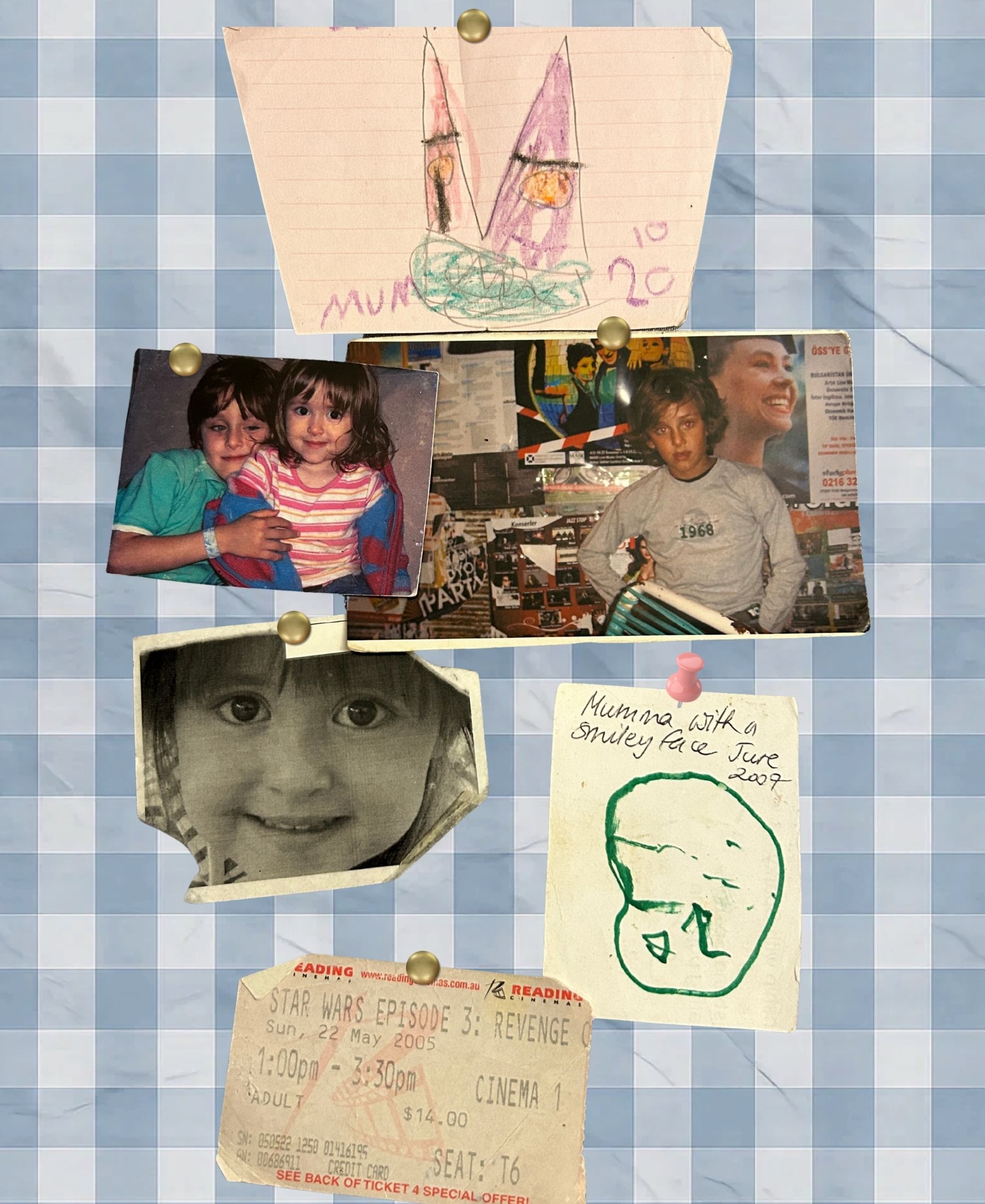
That doesn’t mean I’m not thrilled about being a mum. The photo up the top is a collection of talismans I carry about in my wallet from early in my two kids’ lives.
Some explanations… Apparently, in my daughter’s eyes, I resembled a lima bean.
And, no. The top picture isn’t a bird’s-eye view of Madonna’s cleavage during her Jean-Paul Gaultier pointy-bra era. It’s a church. Which is odd, given that, as a family, we are committed agnostics.
Finally, the movie ticket is there as proof of the power of disappointing sequels; Star Wars: Revenge of the Sith sent me into labour. My daughter was born the next day.
The mess of motherhood.
I am obsessed with my two children.
But I’ll say it up front.
Being a mother can bring the most thankless, messy, heartbreaking, and traumatic moments in a woman’s life.
At the same time, it is also the source of blind love, transcendent delight and uncomplicated joy. Whether it comes the instant you hold your sticky, flailing newborn child in your arms, or it grows over time—it’s different for everyone—the love we have for our children is deep and pure.
But as anyone who’s tried it can tell you, motherhood is a Gordian knot of complications. These days, we’re expected to juggle childcare with household duties, paid work outside the home, further education… the list never ends.
For me, that was the least of my problems.
Guilty secrets.
The thing that surprised me the most about being a first-time mum was the pervasive guilt and sense of inadequacy that cropped up every time a decision had to be made about the tiny, and completely helpless, human being entrusted to my care.
At the time, I was certain that whatever force of nature decided to bring my son into my life had made a terrible decision by nominating me as responsible enough to care for a child.
Thank fuck I was given my mothering training wheels long before social media was a thing.
There was enough contradictory information out there, even then. I had the maternal and child healthcare nurse telling me when my angelic baby son’s face turned into a weeping moonscape of sores that it was likely caused by my choice of baby face wash, and that it would probably clear up by the time he was two. It was gone in a week.
I didn’t need the contributions of @StayHomeMom and @rawdogging_five_under_five telling me that pasteurised milk would turn my baby into a serial killer, and that he would suffer permanent emotional damage unless I carried him around in a sling spun from Tibetan yak hair and blessed by the Dalai Lama.
My 80 per cent rule
Of course, I quickly realised that as long as a baby is fed, bathed, kept safe and—most of all—loved unconditionally, being a mother isn’t as difficult as it feels at first.
I figured my babies were born near-perfect. A few rough edges, sure… and my job as mum was to help them smooth those out so that they didn’t keep snagging on things as they moved through life. But I got to a point where I was going by what I thought of as the 80 per cent rule. If I was getting things right about 80 per cent of the time, then I was doing OK.
Trick was not to fuck them up and inflict callouses and scars courtesy of the sharp edges of my own that life had bestowed upon me.
But it took a while to get there.
Because mums barely have time to breathe.And you know what didn’t help? The spectre of the “bad mother” hanging over my shoulder.
She hovers there, a cautionary tale, showing us exactly what happens if we drop the bundle of joy.
Entry level bad mum: “Bad despite her best efforts”
This is the least malignant of all the bad mums.
The dead mum is a favourite of the animated film genre. Bambi. Finding Nemo. Ice Age. Try it yourself. The “missing mother” trope is a thing.
She’s the mother who causes us all existential horror, because she’s the mum who disappears from her child’s life through no fault of her own. She’s “every mum.” And although she mightn’t have chosen the path herself, the outcome is the same. Her child is left to fend for him or herself.
The wicked stepmother
A void is left behind. Traditionally, that vacuum was filled by the “wicked stepmother.”
Right away, the maternal figure is split in two: the “good,” absent half, and the “evil” half that remains. All the toxic things that can crop up between mother and child can be channelled into the “bad” stepmother, without harming the memory of the missing mum.
The stepmother becomes an outlet to channel taboo feelings.
Think about the mother so fixated on her fading beauty that she goes homicidal on her stepdaughter in Snow White. Or Cinderella’s stepmum playing favourites and forcing her stepdaughter into servitude. Then there’s Hansel and Gretel where a woman lands her stepchildren in the care of a cannibalistic witch rather than finding a way to be creative in the kitchen during a time of famine. And how about the gold-digging would-be-stepmother bent on stealing her daughter’s inheritance in The Parent Trap?
The “wicked stepmother” meme belongs to another era, though; one in which divorce and—shock, horror—re-partnering got society’s collective knickers in a knot.
The stepmum was an easy mark. How easy, you ask? Well, she features as the villain in more than 900 stories from around the world.
Moral of the story? No mum = trouble.
Until a saviour appears.
And, yes. That saviour is usually a man; a heroic man who steps in and fixes everything.
Red Riding Hood’s woodsman. Prince Charming in all his guises. Nemo’s dad. Harry Potter’s Dumbledore. Obi Wan Kenobi in Star Wars. Gru in Despicable Me. Although, in fairness, there is also the odd appearance of a fairy godmother, a magical nanny, or a good witch or two.
The warning? If mum can’t do it, a man will be forced to step in… and do a better job of it, while he’s at it.
The “don’t look back” mum.
The dead or missing mum is one thing. The willingly absent mum is another.
This one’s a cautionary tale for women with ambitions that extend beyond their role as a mother.
These bad mums don’t directly cause their children harm. But the result is the same. They expose their children to danger because they’re choosing their own needs over those of their children.
Think the mum in Coraline, who’s so preoccupied with her own career that she doesn’t notice as her daughter is lured into an upside-down world by “The Other Mother” with the promise of the love and attention she’s missing at home.
Or Mary Poppins’ Winifred Banks whose children run away “for the fourth time this week” while she’s off rallying for a woman’s right to vote. Enter the replacement mum in the form of Mary Poppins, who shows Winifred how mothering should be done, and liberates her—and her children—from her selfish ways.
Even this year’s Oscar-winning film, One Battle After Another, went there, when the heroic militant, Perfidia Beverly Hills, abandoned her child and chose the revolution instead, putting her daughter, Willa, in grave danger. Of course it fell to Willa’s bumbling stepfather to save her.
Think about the message we’re getting here. Mums are out doing noble things that would see men showered in bouquets, but instead they’re sent to the naughty corner to watch their kids punished as a direct result of their perceived failings.
The toxic “smother”
That said, give me a mum who takes time out to protest for women’s rights over a “smother.”
They’re the tiger mums. The helicopter mums. The ones trying desperately to prove that they’re doing it all for their children, somewhere between the guilt-trips, the gaslighting, and the string-pulling.
There are the comedic smothers: George Costanza’s mum in Seinfeld. Arrested Development’s Lucille Bluth.
Then there are the passive-aggressive mums raising topiary children: Betty Draper in Mad Men. Mother Gothel in Tangled. Margaret White in Carrie. And let’s not forget the iconic Joan Crawford, in Mommie Dearest.
And how about Game of Thrones’ Cersei Lannister, whose narcissism and pathological need for control set a new bar for smothers the world over. And, as is always the case with bad mums, all Cersei’s children suffered terrible ends.
Homicidal mum
Neglect and manipulation… not great.
Outright filicide (yes, that’s a word) is another.
The murderous mother has her own chapter in pop culture.
Medea, who murders her own children as payback when her husband, Jason (he of the Argonauts and the Golden Fleece) takes off with a younger woman.
Angelica Huston as Lilly Dillon in The Grifters, who slashes her son’s neck and leaves him to die. Tony Soprano’s mum, Livia, who took out a hit on her own child. The homicidal tendencies of two generations of mothers in the contemporary horror classic, Hereditary.
The monstrous feminine
To this group, I’d add Ripley from the Alien series. It’s a long narrative arc that documents the monstrous feminine.
When we meet Ellen Ripley, she’s a single cat lady living her best life in outer space. In the second film, she hooks up with a fella, adopts an orphan child, Newt, and gives us the now iconic line, “get away from her, you bitch!” when the alien queen is threatening Newt. Ripley responds by killing the egg-laying queen and torching her babies.
Then, in the opening credits of the third film (spoiler alert), we see Newt and Ripley’s lover die as their spacecraft lands on a prison planet populated by men who have taken a vow of celibacy. In full circle, Ripley discovers she’s been impregnated with an alien. When the film ends, Ripley has shaved her hair and is indistinguishable from the male prisoners; she takes her own life, and that of her “child.”
Subliminal fear
I always wonder how much of this is born of subliminal fear at the thought of being neglected when we’re at our most vulnerable by the person we rely on the most for care.
But most of all, I wonder whether it’s spawned by societal expectations in the West that women should always put their own needs below those of their children. Go back to our cave-dwelling prehistoric ancestors, and child-raising was a communal thing. If a kid was hungry, one working boob was as good as the next.
In modern hunter-gatherer societies, babies are in direct physical contact with another human being for 90 per cent of the day. A squalling baby is never left to cry. Someone responds immediately with comforting or nursing.
But here’s the catch. It’s not just the mum doing the comforting.
Africa’s !Kung people, along with many other hunter-gatherer societies, adopt what’s called “alloparenting.” It means that people other than a child’s mother provide almost half their care. A !Kung baby might be handballed between caregivers up to eight times an hour.
Impossible expectations
Is it any wonder we Western mums find it hard to measure up? Even if we’re lucky enough to have a partner who does their bit when it comes to co-parenting, the message we’re given loud and clear is that mums should be doing most of the work. Or bad shit happens.
My point here? I doubt bad mums feature much in !Kung pop culture. Because a village is raising their children.
A !Kung child will never grow up with a subliminal fear they will be neglected or deserted. Because it’s a foreign concept to them.
In the West, that’s not the case. We’re taught that without a “perfect mother,” whatever the fuck that means, we’re cooked.
Barefoot and pregnant
I guess what I’m asking is why the bond between mother and child is portrayed as so sacrosanct in the West that any time a mum feels herself on shaky ground, it’s seen as a threat to society’s fabric?
Does the patriarchy feel so threatened by any woman who dares prioritise her own needs that we get the monstrous mother as a cautionary tale to keep us in line?
There’s no doubt that the powers that be know how important that control is.
Control the mothers. You control the future.
Hitler knew it. As do the policymakers at the Heritage Foundation, who are manoeuvring to remove American women’s right to vote, and force them back to the kitchen sink, where they’ll be chained, barefoot and pregnant.
Mothers make the world go round
I read something the other day that blew my mind.
“All the people on this planet are women and their children.”
Yes, yes. I know. The same could be said for fathers. But that’s not the point here.
We mothers are doing our best.
And it could be a whole lot worse.
If you’re in any doubt, just whack Carrie, Coraline,or Animal Kingdom on the TV.
Happy Mother’s Day.
Enjoyed that? There’s plenty more where that came from. Subscribe and make sure you don’t miss out on whatever happens to be coming along next
