Why I didn’t. And why authenticity still matters in an AI-saturated world.

“Authenticity is becoming infinitely reproducible.”
So says Adam Mosseri, head honcho at Instagram.
You reckon? Yeah, nah. I call bullshit on that.
As a writer, I’ll die on this hill.
Authenticity, by its very nature, cannot be replicated. I think what Adam meant to say was that “the appearance of authenticity is becoming infinitely reproducible.”
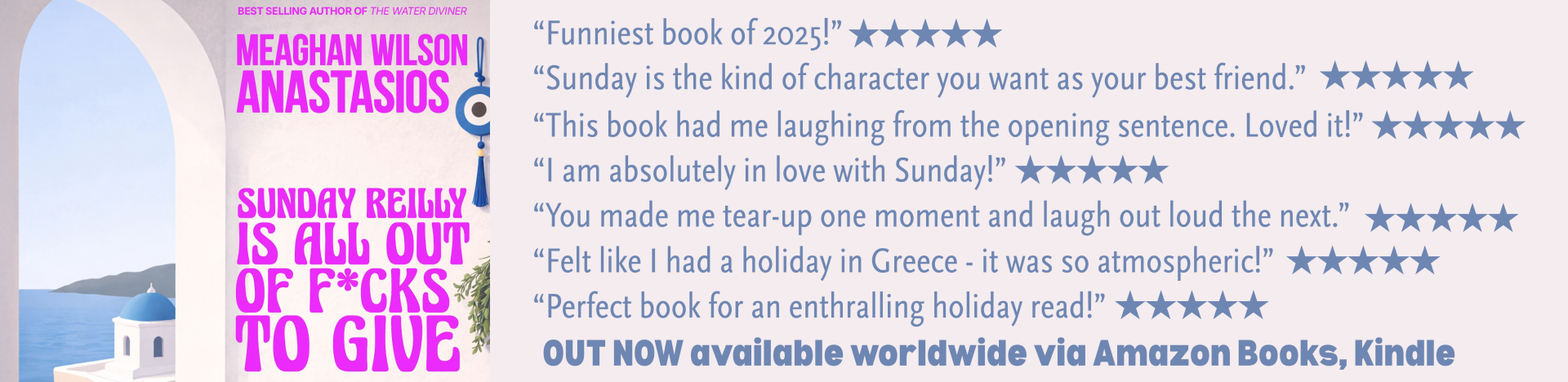
With my latest novel, SUNDAY REILLY IS ALL OUT OF F*CKS TO GIVE, about to come out, that should be bad news.
Because Sunday is, without a doubt, as authentic as you can get.
But as with so many other things in life, it’s not all bad news. In fact, once the dust settles, I suspect we’ll start to see the silver gleaming at the heart of this, admittedly, daunting storm cloud.
It doesn’t change the facts, though.
Generative AI is the most accomplished mimic of all time
And it’s flooding the airwaves at the moment.
It’s a factory churning out replicas.
Nothing it makes can ever be authentic, because even when prompted by a human hand, it’s creating things that draw on a vast reservoir of bits and pieces stolen from human beings.
It’s not seeking inspiration from other creative work, which is something all artists do. It’s putting together a grab-bag of well-chosen cultural fragments and gluing them together to create a pleasing chimera that does a pretty bang-on job of looking real.
Does that make it “authentic”?
Fuck, no. I’ve got a fabulously convincing Prada handbag a friend bought me from a market in Istanbul. When I use it and am dressed up to the nines, I’m sure people believe it’s the real thing. But just because it looks real doesn’t make it so.
Roll a shit in glitter, and it’s still just a shiny turd.
Sick of the slop?
This isn’t the first time I’ve written about this. But given the way it’s impacting on my way of life as a writer, it’s become a preoccupation.
As someone who has relied on middlemen and women to get my product out onto the market, the decline of the traditional means of transmitting and consuming cultural products has been a massive blow to me and other creatives like me.
While people like Adam Mosseri crow about the demise of institutions and gatekeepers that stood between creatives and their audiences, they fail to acknowledge that the for-profit businesses they represent—global leviathans like Meta and Amazon—are simply filling the shoes vacated by traditional publishers and distributors.
Yes, creatives can reach their audiences directly. But they’re now beholden to an algorithm that determines whether their work will be seen. Put a foot wrong, and they pull the rug out from under you.
With the management changes at the top at Meta, who knows where its social media platforms are headed.
But—and it’s a big “but”—there is one aspect of this shitshow that gives me cause for optimism. Because at the moment, I’m trying it on for size.
The creator economy
I suspect we’re finding our way to a place where “authenticity” means warts and all.
Mosseri and his friends put out a call for “content that feels real.”
How about just content that actually is real?
In that sense, the shift from content curated by institutions and gatekeepers to a world where creators are in direct contact with the people who like whatever it is that they do is a move in the right direction.
A big publishing house might need projected sales figures in the six- or seven-figure range to make a book viable.
But as a sole trader, sales numbers ranking in four- or five-figures could mean a living wage.
Meet picture-imperfect
As an author, that prospect is exciting.
When the work I make is raw, real, and from the heart, I’m creating something that only I can produce.
The online world is done with filters. Nobody wants to see picture-perfect anymore. Not now that anyone can create that with a two-line prompt on ChatGPT.
Perfect can’t exist, because we can no longer believe our eyes.
Post an idyllic scene of a sunset, or the perfect shot of your cat lounging in the sun, and watch the critics descend… “C’mon. That’s AI.”
That’s a problem.
Because believing our eyes is a survival mechanism.
Our hormonal system is programmed to respond to visual prompts.
First responders talk about guardian angels.
Like the firefighter who knew it was time to leave the building, even if she had no idea why… she was responding to tiny warnings in the fire’s behaviour; things her eyes registered but bypassed her conscious mind and triggered her fight-or-flight instinct.
These are triggers set in place by many years’ experience. That’s the “voice in the head” that keeps us from harm.
Be. More. Human.
At the moment, the uncanny quality of so many AI-generated images makes them so many shades of wrong-town. But that will change. Soon.
When we’re sick of drowning in a deluge of AI generated slop, I’m hoping it will lead us to a place where the picture-imperfect will reign supreme.
That’s the secret. Picture-imperfect.
If you’ve met me on Threads—Meta’s version of the app once known as Twitter—you’ve seen Meaghan unfiltered. For better or worse.
In a sense, it’s where I am the most honest about who I am, other than within the safe embrace of the people closest to me in the non-digital world.
I’ve worn so many masks in my life, it’s the one place I can express what I’m thinking without fear of blowback on the people I love.
I’ve found my voice. It’s real. It’s me. It’s authentic. And I’m loving it.
It’s also the voice you’ll hear in SUNDAY REILLY IS ALL OUT OF F*CKS TO GIVE.
Authentic me
The word authentikós comes from Ancient Greek. It means a “person accomplishing something on their own” (also, strangely, killer, or murderer. But that’s a story for another day).
Authenticity in the creative industries has always been a big thing.
Authentic means “real.”
Authentic is a mark of value.
Take the example of the art print.
Prints were traditionally a way for visual artists to improve the bottom line. Not that you’ll find too many people admitting that. As is the case with so many things in the art world, it’s a dirty secret because talking too much about the long-term love affair between art and money demystifies the process.
Early European printmakers like Rembrandt and Dürer mastered the art of printmaking to sell more art, and to promote their talent to a wider audience.
Why? Because an artist can only sell a painting once. But a print that allows an artist to make hundreds of copies in an instant, relatively speaking…
Now, that’s a money-spinner
It’s why the signed, limited-edition print emerged after the invention of photographic reproduction.
People want REAL authenticity in their works of art. They want to know that a human being made the object they’re buying.
Once photographic reproduction became a thing in the 20th century, and there was the opportunity to make infinite replicas of artworks, an original signature and number became a way of proving that a human being had been involved with the production.
As an aside, if you find a “signed, limited edition” print of anything pre-1900, someone’s taking you for a ride. I say that with the authority of someone who ran an art auction business, and has a PhD in art history, and was a lecturer at university specialising in the art market. Yeah. Really.
Chaotic career? Yeah. You betcha… TAKE THAT, AI!
AI can’t understand authenticity
It’s easy to forget that AI’s understanding of what it means to be human is limited to what it sees online or is fed through the theft of many thousands of literary works (including four of mine).
It can’t be there with us in the darkest hours either side of midnight as the demons descend.
It’s not lying beside us in the euphoric afterglow of a spectacular roll in the hay.
And it can’t ever know what it’s like in that floor-dropping-away-from-you moment when you receive the worst possible news. I’ll never forget the moment my husband—the strongest person I know—literally gave way at the knees when given terrible news about his brother.
AI can only ever process those things as described in the words it devours. And even the best wordsmiths can only ever capture a pale shadow of those moments. In part because every single one of us experiences them differently.
My “authentic” is not going to be the same as yours.
Chaos theory
AI can’t understand the crazy wiring that goes into being a human being.
As the algorithm tries to replace connoisseurship and become your in-house content curator, it believes it understands you better than you know yourself.
But we’ve all seen how completely wrong it can be.
Jump on Netflix and look at the things it’s pushing into your feed.
Just because I like a bit of brain candy and watch Real Housewives of Beverly Hills while I’m cooking, doesn’t mean I need to be fed every version of the franchise, thank you very much.
Where’s the thrill of discovery? The joy of browsing the shelves in the video store?
Human beings are unpredictable
It’s our greatest strength, and our greatest flaw.
The groundbreaking series Pluribus captures that in spades.
And it’s why I find myself on the journey I’m on right now.
Because despite being an established author with multiple books published traditionally, I’ve decided to follow a different path with my latest novel, SUNDAY REILLY IS ALL OUT OF F*CKS TO GIVE.
Why? Here’s the rationale.
Is it possible to have three watershed moments?
I can’t be fucked looking that up. So, I’m going with it.
Number one watershed.
I’m an AACTA accredited screenwriter, (truth – look me up… as I say, chaotic? and then some).
So, of course, as Sunday Reilly’s story unfolded on the page, I was imagining how she’d look onscreen. I wrote a pitch document and a pilot episode for a series and showed it to a male producer I know.
His response? “Sure, it’s funny. But it’ll be a hard sell making something that will have half the audience reaching for the remote.”
Yes. Really.
Even as we drown in a tsunami of hyper-masculine, dick-swinging shit (Landmen, anyone?), a story about a woman rediscovering herself and having crazy fun times on a Greek island is a “hard sell”?
Yeah. Fuck that.
Number two
As I was tweaking my pitch to publishers, I reached out to an industry contact for advice. Her suggestion? Take “F*CK” out of the title, because it will make my novel less appealing to publishers who would find it difficult to sell to big retail chains and promote to mumsy book clubs.
I mean, sure. She could be right.
But I didn’t want to let that go. So, again, my response was: “fuck that.”
The nail in the coffin?
Was “f*ck” the thing that sunk me with the first publisher who met Sunday? Could be. Colour me a kaleidoscope of “all out of f*cks to give.”
Not that the rejection didn’t hurt. It always does. Badly.
You can get a little sense of it from an excerpt from my novel.
Because, yeah, she’s an author as well. Write what you know, right?
I write because it’s a compulsion. There are worlds in my head pleading to get out. And the people I bring to life in the pages of my books are like family. They are composites of me and mine. For those things to be rejected by Charlotte fucking Werner in as grim a spot as the Fountain Springs shopping centre is a lot more than a blow to my pride. It’s a rejection of me and people I love. It’s banishing my papery family to a dark place where nobody will meet them and come to love them as I do. That wound to my soul won’t heal in a hurry.
So, that’s Sunday’s experience. Mine was no different.
Where’s my happy ending?
I know how the rest of this story goes. That’s because I’ve been on the traditional publishing merry-go-round a few times now.
For those of you who haven’t, let me give you an idea about how it works.
An important caveat here: none of what follows is a criticism of the professionals involved in the process. They’re all next-level busy. This is just how the time factors play out, unless you’re J.K. Rowling and they’re waiting on your next novel. I imagine it moves a little faster for her.
· Give finished manuscript to agent.
· Wait for agent to read: 2 months.
· Gently prod agent for a response.
· Agent makes suggestions for some edits.
· Rewrite: 4 months.
· Agent gives manuscript to chosen publisher.
· Wait for publisher to read: 2 months
· Gently prod publisher for a response.
· Publisher suggests working with an independent editor to address “speedhumps” in the manuscript.
· The booked-out editor makes time for your manuscript: 2 months
· Editor presents suggested adjustments.
· Rewrite: 3 months
· Give manuscript back to publisher.
· Wait for publisher to read: 2 months
· Gently prod publisher for a response.
· If all goes well and the publisher wants your novel, bravo! More edits and rewrites follow, but your book will eventually end up in a bookstore: 4-6 months minimum.
· If it doesn’t, the publisher says, “yeah, nah, thanks, it’s not really my speed after all.” And the process begins all over again.
So, that’s at least a full year before you’ll find a publisher for your manuscript, even in a best-case scenario. But because it’s not regarded as kosher for an agent to shop your manuscript around to multiple publishers at the same time, it can take years before you find someone who’ll take you on.
I’m not known for giving up.
So, once I recovered from that awful, squelchy, feeling, I picked myself up and planned the next salvo.
In the wake of getting the “thanks but no thanks” response from the publisher, I asked a friend in the industry for advice about where my agent should take it next.
Her response, given who she is, shocked me. “Fuck the middlemen!” she said “Do it yourself. There’s a reason the New York Times bestsellers list is full of self-published authors.”
I’d love to tell you who it was. But it would be the betrayal of a friendship.
But the more I thought about it, the more I liked the idea.
Because SUNDAY REILLY IS ALL OUT OF F*CKS TO GIVE is a story for now.
It’s me, now.
It’s the world, now.
And we’re all out of patience.
Leap into the unknown
So, I decided to take matters into my own hands. Overnight, I went from feeling rudderless and desperate, to soaring.
Will this work? Who the fuck knows?
But as I’ve tapped into skills I’d forgotten I had and taught myself the ins and outs of getting a book onto the market, I’ve felt superhuman.
And on 20 January, SUNDAY REILLY IS ALL OUT OF F*CKS TO GIVE makes her debut as an eBook and paperback.
Yes, I’ll cock some things up.
Sure, Sunday may sink without a trace.
But hundreds of you have already been on her journey. And your responses – formal on Goodreads, and informal in posts on Threads – have brought me to tears. Because you love Sunday as much as I do. And that’s what counts in the end.
It’s been worth it, just for that.
It’s not about the money
It really isn’t.
If it is? I’m in the wrong business.
Even through traditional publishing, you get between $1 and $2 per paperback. So even on my biggest selling novel to date, The Water Diviner, which sold 45,000 copies, I was paid $90,000. There’s no retiring to the Aegean on that.
For me, that doesn’t matter. Sure, it’d be nice. But that’s not why I do what I do.
I write to reach people. Even when I’m messing around over on Threads, I’m doing it with intent.
The world is a big, and increasingly terrifying, place. The thing that will save us all is our shared humanity.
That’s why I write.
To touch you (in a completely appropriate, above-the-sheets, kind of way).
To make you stop and think.
To make you laugh, cry, and cheer. All the feels.
To transport you to other places.
To introduce you to new worlds and new people.
To distract you from the everyday.
To give you hope that there is a better place out there.
And to show you that, in the long run, we’re all going to be OK.
That’s my message in SUNDAY REILLY IS ALL OUT OF F*CKS TO GIVE. Even when the storm clouds stretch to the horizon, they will eventually pass.
The one constant is the blue sky in the heavens above, just waiting for that day.
This is my world.
And this is my take on “authenticity.”
Are you with me?
I hope so. And if you join Sunday and me on our bonkers escape to the Greek islands, I’m pretty sure we’ll give you plenty of reasons to smile.
If you do, then my work here is done.
